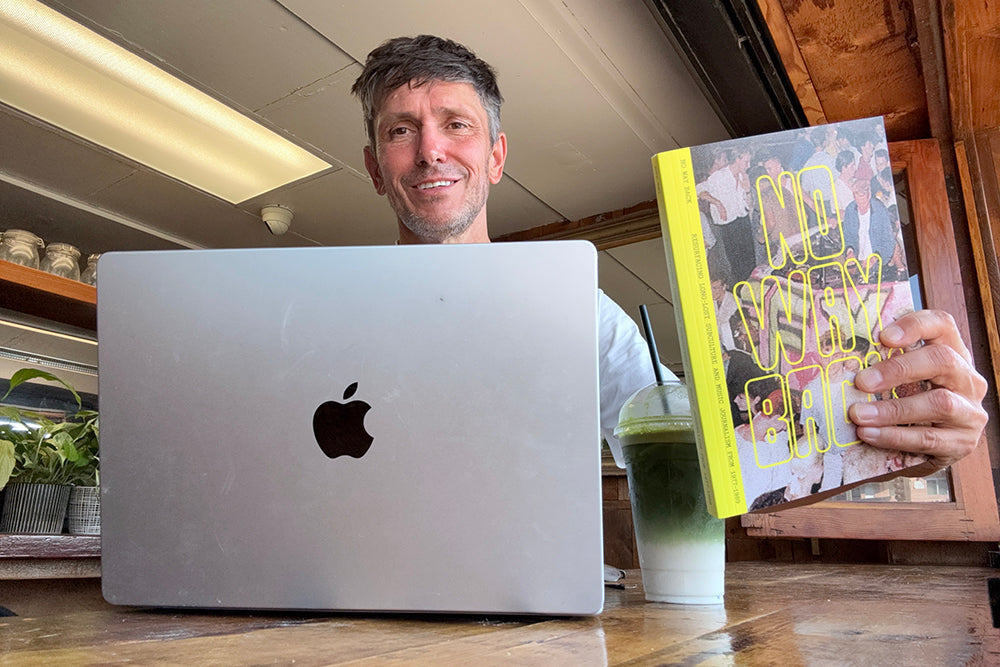
Andy Crysell, No Way Back
No Way Back is a fascinating new magazine that republishes music and pop culture writing from an earlier era. Issue one looks at post-punk London and New York.
While the selection of material is spot on, what lifts the magazine beyond simple nostalgia is its presentation; as well as writing from magazines of the time, including Sounds and Ritz, there are photographs of the original texts as they appeared in print, and each piece is contextualised and updates given where needed. There are also several brilliant archive photo stories from the period. The result is a well-researched publication that gives genuine insight into the times.
The project has been launched by Andy Crysell and Mark Maddox, both veterans of music publishing who, after a period doing other things, have circled back to print. Here, Andy explains more about the thinking behind No Way Back and how the two came up with the line ‘Learning from, not longing for, the past’ to summarise their intentions.

What are you doing this morning?
I like mornings, which is a stroke of luck as I have a lot of morning in front of me. I always wake up around 5am. Often I go for a run and as I’m in Los Angeles at present, this means it was dark when I started running. I stopped roughly when it was turning light and got a coffee from the nearest place (I rarely have breakfast). I then walked back, thinking about things to do.
Today, that includes early video meets with people in London and New York. Also some planning work for No Way Back—both the next issue and where we (that’s me and my partner in No Way Back, Mark Maddox) can take this idea more broadly. Plus there are various other projects I’m working on. Right now, that’s a mix of editorial things and consulting things. I’m doing some advisory work for the Museum Of Youth Culture back in London; also the Black representation non-profit 20/20 Levels. I’ve got an article to write for a trade mag, and I’m working with a few businesses on how they grow. There’s a lot of mode switching in all of that, but it suits me.
Around 10am, I’ll head out somewhere different to work. This ‘somewhere’ might be guided by someone I’m meeting with. If not, I tend to pick a place at random—Silver Lake, Downtown, Studio City etc. Today, I’m meeting someone up on Glendale Boulevard—he has a new artist management business to tell me about. After that, I’ll stay put for a couple of hours to get some more work done. Mid afternoon onwards, I might keep at the work on my laptop if I’m feeling motivated. Otherwise, I’ll go do other stuff and just write notes and respond to things as I go via mobile.
Describe your work environment
I guess like lots of people these days, I’m less into the idea of having one place to work and more motivated by having lots of places to work. More so still in the last couple of years, where I’ve been dividing my time between New York and London. And generally being pretty itinerant on top of that as well. Hence being here in Los Angeles, and having been in Austin just before.
If things had gone to plan I would be staying in a cool little bungalow in Venice—somewhere I’ve stayed in, and liked working from, before. For reasons not that interesting, things didn’t go to plan. So instead I’m staying in a remarkably bland apartment in Marina Del Ray—savage lighting, artex on the ceiling and a pretend wooden table I’m currently typing from. This place does, however, have an immense view of hundreds of flat top roofs, with the Pacific Ocean and LAX in the background. It’s ugly and awesome, all at once.

I always, obsessively, have music on when I’m working. Lots of Spotify but also Soundcloud, a bit of Bandcamp and radio platforms like NTS and Worldwide FM. Sometimes I’m listening to it, sometimes it's more of a low-key electronic hum that keeps my head in a good place. Last week, I made a concerted effort to check out new and new-ish releases. This week, it’s been a lot of pleasantly sombre Basic Channel.
Wherever I working, and even though I really have everything I need on my laptop and phone, I like to have a few physical objects to place on the table. I suppose it has an anchoring effect. Right now, on my travels, that limits me to Hanif Abdurraqib’s ‘Go Ahead In The Rain’ (one of those books that says it’s about a thing—A Tribe Called Quest—but has you wondering if it’s really about other things; will get back to you on that), a copy of Wax Poetics (love the Tony Wilson In NYC feature in it) and Stephen King’s ‘On Writing’ (I’ve been transporting it around for ages without reading it. The cover pic is a winner, however).
 Which magazine do you first remember?
I’m sure like lots of people of my age who grew up in the UK, the answer is Smash Hits. At the time I just saw it as bright and colourful, full of good haircuts and nice clothes and a conveyor belt of cool new pop stars. It’s only when you read copies years later, and hear about how they were seeking to reinvent the rules of pop journalism, that you realise how smart and pivotal it was.
Guilty secret: I also liked Look In, which was a bit like Smash Hits except not nearly as smart or pivotal. It did have a lot of stuff about TV in it, though. If you wanted to stay up to speed with ‘The Six Million Dollar Man’ or ‘Mork & Mindy’, it was important.

Aside from yours, what’s your favourite magazine/zine?
Like asking about all time favourite albums, I could give you endless different answers. But a consistent one would be Interview. The way it threw together high and low culture, underground ideas, consumerism and just being a loose conversation. It’s so of that period and that place—but I also wish more modern media, offline or online, would take cues from it.
However, today’s more specific choice is Collusion magazine. It was conceived in the early 1980s by the writer and musician David Toop, along with Sue Steward and Steve Beresford. It only ran for a few issues. Visually, it’s very of its time, but it has a freshness in how it joined the dots between different forms of music. Saying you have an eclectic taste in music is actually quite boringly normal these days, but back then people were far more inclined to stay in a lane. Collusion was an early sign of that getting shaken up.
I got to Collusion via an unusual route. Back in the 1990s, way before I’d seen the mag itself, I had a photocopy of a very long feature from it called Behind The Groove. It documented the lives and creativity of DJ/producers like Larry Levan, Francois Kervorkian, David Mancuso and Walter Gibbons. It talked about the roots of mixing and clubs like The Loft, Better Days and Funhouse. Both directly and indirectly, it spoke about the impact of AIDs, marginalisation, gangs, drugs and early signs of gentrification.
In days before the internet, it felt like the one and only portal available into that world. People had photocopies of photocopies of photocopies. You could buy copies at Camden Market. Loads of DJs and journalists talk about how important it was for them. In a nice full circle moment, it’s one of the pieces that we have lined up for our second issue.

What other piece of media would you recommend? And why?
Since I broke the rules by namechecking two mags, I’ll stick on that path. Both are books that I’ve recently re-read and got even more from the second time around. One is ‘Barbarian Days’ by William Finnegan. It’s a book about living a surfer’s life. But take all of the waves and rides out of it and it’s also just a beautifully written book about being a human and coming to terms with who you are.
And ‘As Serious As Your Life’ by the jazz author and photographer, Val Wilmer. She writes about Ornette Coleman, John Coltrane, Albert Ayler and Sun Ra in ways social and political as much as musical. The writing aside, I also think it’s incredible how this young woman from Streatham in south London persisted and persisted until she found a way into that scene.
 Describe No Way Back in three words
Old but new.

How did you avoid the project being merely an exercise in nostalgia?
That challenge sits at the heart of everything we’re trying to do. I don’t think there’s anything wrong with looking back. In fact it’s an inspiring and quite natural thing to do, and clearly lots of younger people like to do it, too—often to times and events they didn’t experience firsthand. But it’s about what you make of the backstory and what you certainly shouldn’t do with it is descend into back-in-my-day bitterness.
We came up with the line ‘Learning from, not longing for, the past’ to summarise what our intentions are. It’s about ideas and guidance for where creativity goes next. In terms of then bringing that ambition to life, it’s in how you present the work, the conversation you build around it and the people you invite into that conversation.
I also think there’s something appealing in No Way Back that the writers and photographers documenting these breakthrough moments had no idea of the long and influential journey these genres and styles would wind off on. There’s no post-rationalisation or revisionism.

One of the best elements in thsi first issue is the way you mix London and New York. Was this deliberate?
It was. We didn’t specifically set out to exclude other cities—and Frankfurt gets a look-in, courtesy of Kraftwerk. But we always knew there’d be an emphasis on what was happening in London and New York in that period. And importantly, in my view, the interplay and the relationship they had with each other. I think there was a very rapid kind of cultural conversation going on.
Where it will get interesting is in future issues, as we start to consider other ways to resurface stories from the past. I’m sure plenty of other cities will start to feature, and other eras as we develop it, rather than it just being about the post-punk period. And potentially moving the focus to design and media rather than purely music.

The picture research is a vital part of the project; describe the process of sourcing the original photography and the shots of the stories as they originally appeared in print
The imagery became so important and really lifted No Way Back away from the more book-like format it could have taken (though can we please not call it a ‘bookazine’—I’m struggling with that term!). All the credit for tracking down rights and permissions that were often sitting in very deep wormholes goes to Mark. Also to our design duo, Daniel McGhee and Lee Belcher, for finding so many of the original covers and spreads. Some were surfaced relatively easily; others were quite the epic journey—libraries, eBay, personal collections, the lot.

What do you hope the reader will take away from No Way Back?
That they find new dimensions and different sensibilities in stories from our subcultural past that often have been flattened and stripped of context over the years. That pioneers whose stories have been marginalised are made more visible.
Secondly, that it triggers some actions, encouraging people to carry something through into their own creativity, or simply into how they think about culture, art, music, media and trying to do good things in often unsympathetic cities.

Please show us one spread that sums up how the magazine works, and explain why you selected it
This one shows off a lot of what we’re getting at: presenting the article, extracted as copy, but showing the material in its original form as well—the spreads and the covers. The layers this creates are important to the pacing in No Way Back but also in how its contents makes you feel. This particular example is about Spandau Ballet, just as the so-called new romantic movement is emerging. I love the way they talk about pushing back against those who won‘t accept that working class youth might like to dress up, have fun and create their own forms of entertainment and expression, rather than be angry and downtrodden.
What has publishing the magazine taught you that may be helpful to anyone else planning to launch one?
Plenty of the advice that tends to get thrown around is, to my mind, optional. For some, thinking about what the audience wants is important; for others just doing what you want to do is all that matters. Perhaps you want to consider your magazine as a brand, all of the channels, platforms, and revenue streams it can extend across. Or maybe it’s just about the print and nothing but the print. Again, there’s no right or wrong there.
But I would definitely say do it with people you enjoy working with. Where there’s reciprocal trust, and a happiness to learn as you go - and probably make a few mistakes as you go, too. People you can very easily spend an extraordinary amount of time chatting with, thinking out loud over what this thing you’re creating can grow into. That’s what we’re lucky to have with No Way Back. That’s where the fun is today and also what will make it a sustainable.
And be prepared to live and breathe it. You need to be a little bit obsessive. By a little bit, I mean very-very. I don’t think there’s much point in starting unless that’s the case.
What are you most looking forward to this coming week?
I’m flying back to New York tomorrow. It’s looking a busy week. I’m speaking at an event, presenting a keynote about my other recent book project, ‘Selling The Night’. More typing, less curating involved with this one. It’s a book exploring what happens when club culture meets brands, advertising and the creative industries and it’s taken me to some lovely places to talk about it.
I’m catching up with various people, including a friend whose son, like mine, has ASD. When we first got to know each other we mainly talked about music. Now it’s about fatherhood, sharing our sometimes chaotic experiences of it and how it’s made us feel across the years. I’m doing an interview for a podcast. I’m going to a big outdoor show with Jamie xx, Carl Craig and others. I’ll probably go watch a Mets baseball game, and I’ll definitely be working on the second No Way Back. We’ve circled a bit on the direction of it, but now we’ve landed on what we feel is right.
I’m no doubt in the minority here, but I’m someone who enjoys working on air flights, so I’m even looking forward to that (a bit). Not sure if it’s the confined space, low oxygen (which apparently helps ‘tunnel vision’ thinking), the background drone, the built-in deadline. Flights are good for getting heavy lifting work done, and LAX to JFK is an ideal length. High productivity over the Midwest.
Editors Andy Crysell and Mark Maddox
Designers Daniel McGhee and Lee Belcher (BAM)